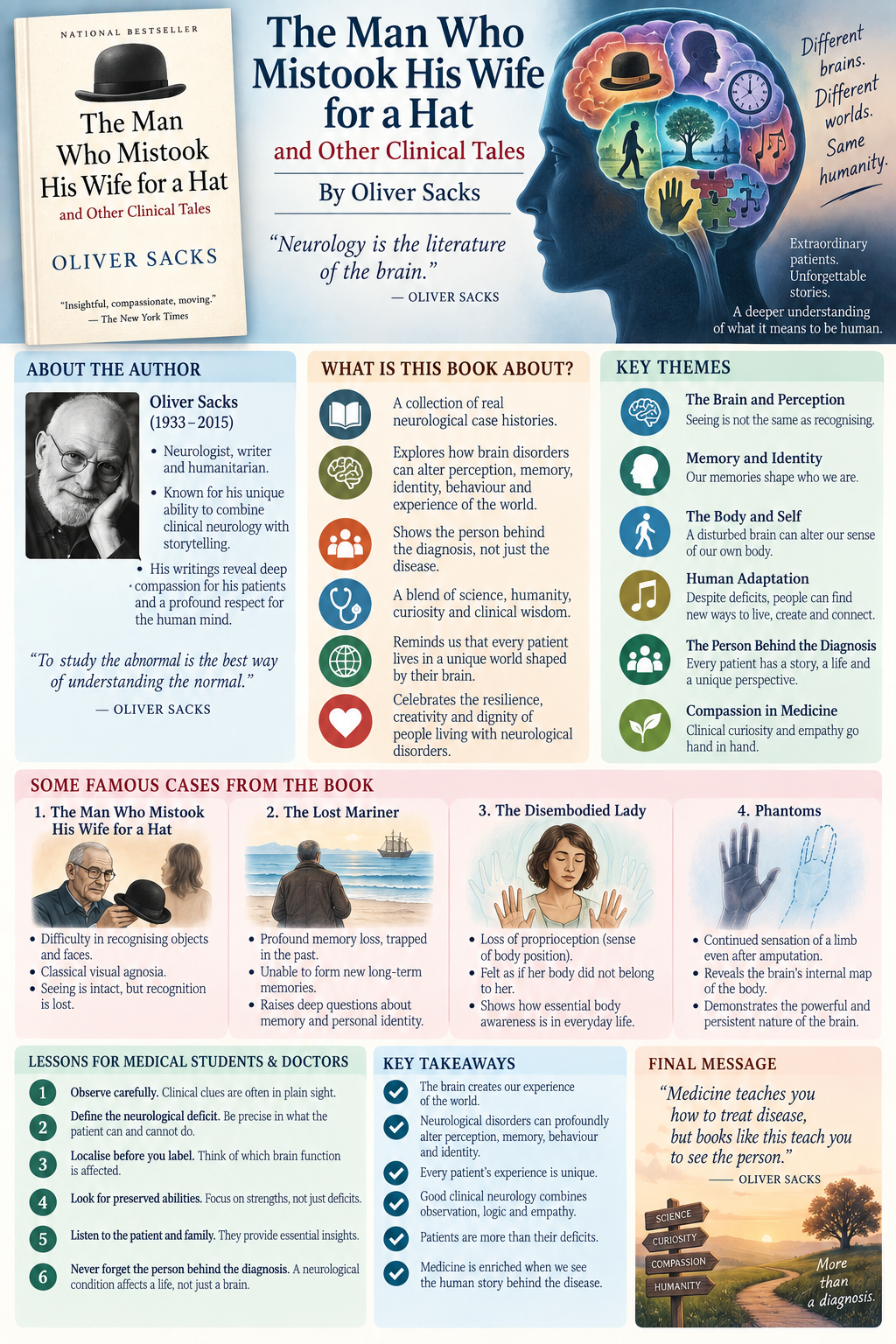
THE MAN WHO MISTOOK HIS WIFE FOR A HAT
By Oliver Sacks
INTRODUCTION
The Man Who Mistook His Wife for a Hat by neurologist Oliver Sacks is a collection of extraordinary neurological case histories.
But calling it simply a neurology book misses its real significance.
Sacks does not merely describe:
Lesion → Deficit → Diagnosis.
He asks something deeper:
What happens to a person's identity when the brain changes the way they experience reality?
The book teaches clinical neurology through human stories involving disorders of:
• Perception
• Memory
• Recognition
• Movement
• Language
• Body awareness
• Intellectual function
• Identity
Above all, it reminds clinicians:
Never allow an interesting neurological diagnosis to make you forget the human being experiencing it.
---
THE MAN WHO MISTOOK HIS WIFE FOR A HAT
The title comes from one of the book's most famous cases.
A musician, referred to as Dr. P, has severe difficulty recognising objects and faces despite being able to see.
His eyes work.
But his brain cannot correctly interpret what he sees.
At one point, he reaches toward his wife's head as though he is trying to pick up his hat.
The problem is not blindness.
It is a disturbance of visual recognition—classically understood as visual agnosia, with prominent difficulty recognising faces and complex visual wholes.
The case beautifully demonstrates an important neurological principle:
Seeing and recognising are not the same neurological process.
---
THE BRAIN DOES NOT SIMPLY "SEE"
When we look at an object, it feels effortless.
We see a cup and immediately know:
"That is a cup."
But neurologically, multiple processes occur.
Visual information must be:
Seen
↓
Processed
↓
Integrated
↓
Compared with stored representations
↓
Recognised
↓
Given meaning
Damage to particular neural networks can interrupt this sequence.
A patient may therefore see perfectly well yet fail to understand what they are seeing.
This is one reason neurological examination can be so fascinating.
---
THE LOST MARINER
Another memorable case involves a man whose memory appears trapped decades in the past.
He can converse normally.
He has personality.
He can reason.
But he cannot reliably form new lasting memories.
The world continually becomes new again.
This raises a profound question:
If our memories disappear, what happens to our sense of identity?
Memory is therefore not merely a cognitive function tested during neurological examination.
It is part of the architecture through which we construct our personal story.
---
THE DISembodied LADY
Sacks describes a woman who loses proprioception—the internal sense that tells us where our body parts are without looking at them.
Normally, you can close your eyes and still know where your arms and legs are.
We rarely appreciate this ability because it operates automatically.
When proprioception is severely impaired, even ordinary movement becomes extraordinarily difficult.
The case demonstrates an important clinical principle:
Some of the most essential neurological functions are invisible until they disappear.
---
PHANTOMS
The book also explores phantom experiences.
After losing a limb, some individuals continue to experience sensations as though the missing limb were still present.
The phenomenon illustrates an extraordinary concept:
The brain's representation of the body does not necessarily disappear when part of the physical body disappears.
The nervous system therefore contains an internal representation—a kind of neurological map—of the body.
---
NEUROLOGY AS DETECTIVE WORK
Sacks' cases demonstrate why neurology often resembles detective work.
A strange behaviour may initially appear psychiatric.
An unusual movement may appear voluntary.
Failure to recognise something may appear like poor vision.
Memory disturbance may be mistaken for confusion.
The clinician must ask:
Which neurological function has actually been lost?
Then:
Symptom
↓
Define the neurological deficit
↓
Identify the affected function
↓
Localise the likely neural system
↓
Construct differential diagnoses
↓
Determine the underlying disease
This remains one of the foundations of clinical neurology.
---
THE PERSON BEHIND THE LESION
Perhaps the greatest strength of Oliver Sacks' writing is that he does not reduce people to lesions.
A conventional case presentation might say:
"Patient with visual agnosia."
Sacks asks:
What does the world look like to this person?
How does the person compensate?
How does the illness affect relationships?
What abilities remain intact?
How does someone rebuild life around a neurological deficit?
This transforms the clinical case into a human story.
---
DEFICIT IS NOT THE WHOLE PERSON
Neurology often focuses on what has been lost.
Memory lost.
Language lost.
Recognition lost.
Movement lost.
Sacks also pays attention to what remains.
Music.
Emotion.
Routine.
Creativity.
Spirituality.
Relationships.
Habit.
Personality.
Patients may sometimes develop remarkable compensatory strategies.
This teaches an important principle:
A neurological disorder may alter part of a person's function without completely defining the person.
---
OBSERVATION: THE FORGOTTEN CLINICAL TOOL
Modern medicine increasingly depends on:
• MRI
• CT
• EEG
• Laboratory testing
• Neuropsychological testing
These are invaluable.
But Sacks reminds us of something fundamental:
Before investigating the patient, observe the patient.
Watch how they:
• Enter the room
• Speak
• Look around
• Recognise objects
• Move
• Respond to instructions
• Interact with relatives
• Compensate for deficits
Sometimes careful bedside observation reveals the neurological syndrome before any investigation does.
---
LESSONS FOR MEDICAL STUDENTS
1. DEFINE THE DEFICIT PRECISELY
Do not simply write:
"Patient is confused."
Ask:
Is attention impaired?
Memory?
Recognition?
Language?
Orientation?
Executive function?
Perception?
2. LOCALISE BEFORE YOU LABEL
Clinical neurology becomes easier when you first determine which function and anatomical system are affected.
3. OBSERVE BEFORE YOU INVESTIGATE
A neurological examination begins the moment the patient enters your view.
4. LISTEN TO THE FAMILY
Some neurological deficits are not recognised by the patient themselves.
Family members may provide crucial information about behavioural or cognitive changes.
5. LOOK FOR PRESERVED ABILITIES
Neurological examination should identify not only what the patient cannot do, but also what they still can do.
6. NEVER TURN A PATIENT INTO A "CASE"
An unusual neurological syndrome may be fascinating academically.
For the person experiencing it, however, it is their everyday life.
---
CLINICAL PEARL
When confronted with a bizarre neurological symptom, resist the temptation to immediately name a disease.
Instead ask:
"What normal neurological function would have to fail to produce this symptom?"
Then localise that function.
This simple approach converts many apparently mysterious neurological presentations into understandable clinical problems.
---
KEY LEARNING POINTS
• Seeing is not the same as recognising.
• Memory is intimately connected with personal identity.
• Proprioception allows us to know where our body exists in space.
• The brain maintains complex internal representations of the body and external world.
• Neurological examination requires careful observation.
• Precise identification of the neurological deficit helps anatomical localisation.
• Preserved abilities can be as clinically important as lost abilities.
• The patient's experience of disease matters as much as the name of the syndrome.
---
TAKE-HOME MESSAGE
The Man Who Mistook His Wife for a Hat teaches neurology in a way that conventional textbooks rarely can.
A textbook may teach:
Symptom → Lesion → Diagnosis → Treatment.
Oliver Sacks adds another step:
Person.
Behind every abnormal reflex, memory deficit, movement disorder, agnosia or strange behaviour is a human being attempting to understand and adapt to a changed world.
For anyone learning clinical medicine, the lesson is simple:
Examine the nervous system carefully.
Localise the lesion logically.
Understand the disease scientifically.
But never stop seeing the person behind the diagnosis.