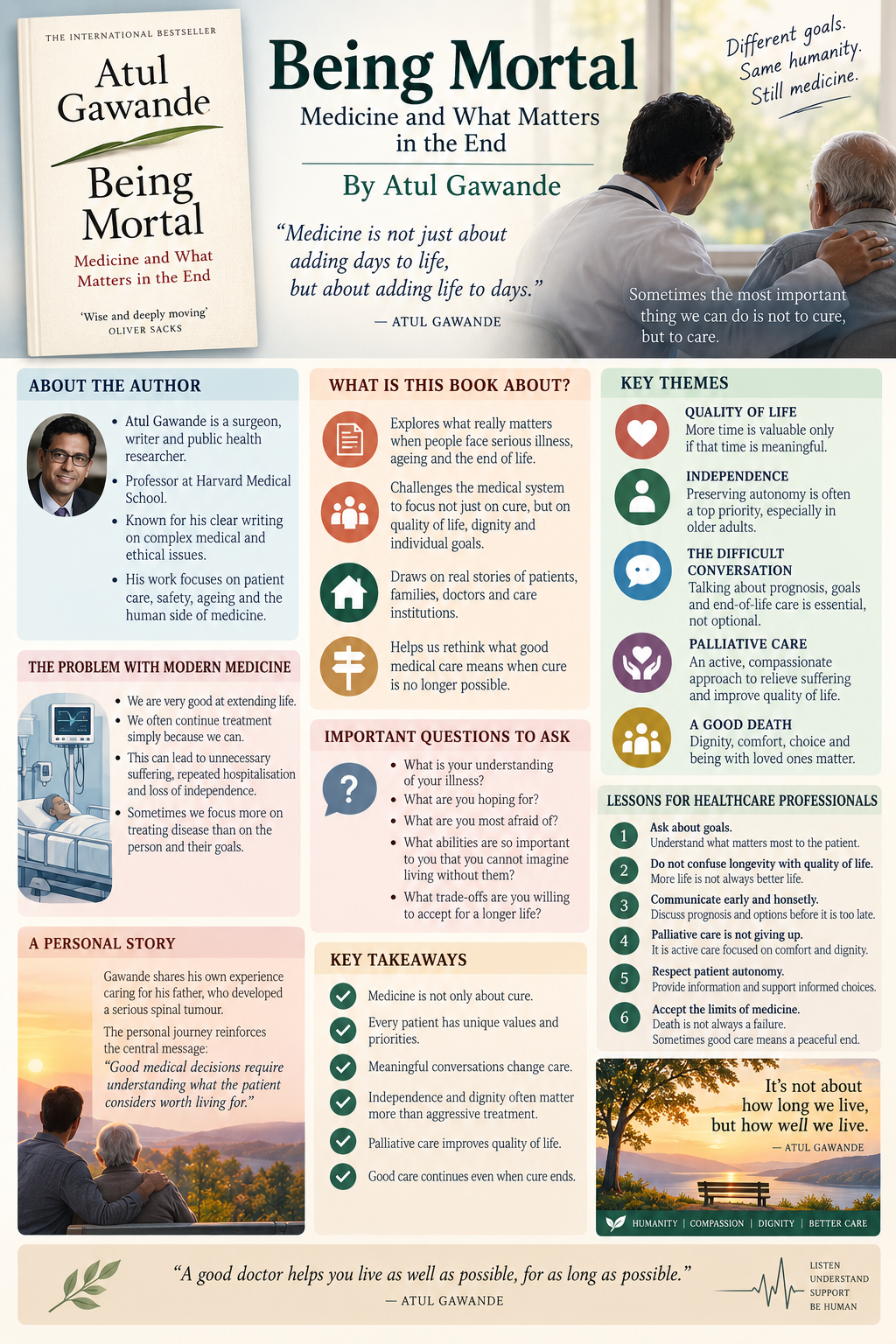
BEING MORTAL
By Atul Gawande
INTRODUCTION
Being Mortal: Medicine and What Matters in the End by surgeon and writer Atul Gawande explores one of medicine's most uncomfortable realities:
What should medicine do when it can no longer cure?
Modern medicine has become extraordinarily effective at extending life.
But extending life and preserving a life worth living are not always the same thing.
Gawande argues that when people develop serious, progressive or terminal illness, medicine often continues asking:
"What more can we do?"
when the better question may be:
"What matters most to this person now?"
---
THE GREAT SUCCESS—AND LIMITATION—OF MODERN MEDICINE
Modern medicine can:
• Treat infections
• Replace joints
• Perform complex surgery
• Support failing organs
• Treat cancers
• Ventilate patients
• Dialyse failing kidneys
• Resuscitate cardiac arrest
• Prolong survival
These are extraordinary achievements.
But medicine's ability to intervene can create another problem.
Because something can be done does not automatically mean it should be done.
Sometimes additional treatment offers little meaningful benefit while adding:
• Pain
• Procedures
• Hospitalisation
• Adverse effects
• Loss of independence
• Separation from family
The difficult question becomes:
When does treatment stop serving the patient and start merely prolonging the process of dying?
---
AGEING AND LOSS OF INDEPENDENCE
A major portion of Being Mortal examines ageing.
Ageing is not a single disease.
It is the gradual accumulation of physiological losses.
Strength declines.
Balance worsens.
Vision and hearing deteriorate.
Memory may change.
The ability to perform everyday activities becomes progressively difficult.
Yet healthcare systems often focus on diseases individually while overlooking what elderly people frequently value most:
Independence.
The goal of an older patient may not be maximum survival at any cost.
It may simply be:
• Remaining at home
• Eating independently
• Walking to the bathroom
• Continuing meaningful relationships
• Maintaining privacy
• Avoiding repeated hospitalisation
Understanding these priorities can completely change medical decisions.
---
THE PROBLEM WITH INSTITUTIONAL CARE
Gawande examines nursing homes and other institutional models of elderly care.
Many institutions are designed primarily around:
• Safety
• Medication schedules
• Nutrition
• Fall prevention
• Staff efficiency
These are important.
But excessive emphasis on safety can unintentionally remove:
• Choice
• Privacy
• Independence
• Purpose
• Familiarity
• Personal identity
A person may become medically safer while feeling less alive.
The book therefore raises an important ethical tension:
How much independence should be sacrificed in the pursuit of safety?
---
WHAT MATTERS TO YOU?
This is perhaps the most important clinical lesson in the entire book.
When facing serious illness, physicians need to understand the patient's goals.
Questions may include:
What is your understanding of your illness?
What are you hoping for?
What are you most afraid of?
What abilities are so important to you that you cannot imagine living without them?
What trade-offs are you willing to accept for the possibility of living longer?
These questions transform medical decision-making.
Instead of asking only:
"Which treatment should we give?"
we begin asking:
"Which treatment best serves this person's goals?"
---
THE DIFFICULT CONVERSATION
Doctors are trained extensively to diagnose and treat disease.
But conversations about:
• Dying
• Prognosis
• Treatment limitations
• Resuscitation
• Palliative care
• Quality of life
can be much harder.
There is a temptation to postpone them.
Another chemotherapy cycle.
Another procedure.
Another ICU admission.
Another intervention.
Sometimes this occurs because physicians themselves find acknowledging mortality uncomfortable.
Gawande argues that discussing death does not mean abandoning hope.
It means redefining hope according to reality.
---
PALLIATIVE CARE
One of the book's major themes is the value of palliative care.
Palliative care does not simply mean:
"Nothing more can be done."
Quite the opposite.
There is often a great deal that can still be done.
We can treat:
• Pain
• Breathlessness
• Anxiety
• Nausea
• Insomnia
• Psychological distress
• Family concerns
The goal changes from fighting disease at every cost toward maximizing the quality of the patient's remaining life.
---
HOSPICE AND DIGNITY
Gawande discusses hospice as another way of approaching terminal illness.
The central idea is not surrender.
It is prioritisation.
When time becomes limited, patients may value:
• Being at home
• Being with family
• Remaining mentally clear
• Avoiding painful interventions
• Controlling symptoms
• Completing unfinished conversations
The measure of success therefore changes.
Success may no longer mean:
How many additional days did medicine produce?
It may mean:
How meaningful and comfortable were those days?
---
THE AUTHOR'S PERSONAL EXPERIENCE
The book becomes especially powerful when Gawande discusses his own father's illness.
His father develops a serious spinal tumour.
Suddenly the theoretical questions become personal.
How aggressively should they intervene?
Which risks are acceptable?
What matters most to his father?
The experience reinforces the central argument of the book:
Good medical decisions require understanding what the patient considers worth living for.
---
THE PROBLEM WITH "DO EVERYTHING"
In critical illness, families sometimes request:
"Doctor, do everything possible."
But "everything" may include:
• CPR
• Intubation
• Mechanical ventilation
• Vasopressors
• Dialysis
• Repeated invasive procedures
• Prolonged ICU admission
The physician's responsibility is not merely to list these interventions.
It is to explain realistically what those interventions can and cannot accomplish.
The important question becomes:
Will this treatment help the patient achieve what matters to them?
---
LESSONS FOR MEDICAL STUDENTS & DOCTORS
1. ASK ABOUT GOALS BEFORE RECOMMENDING TREATMENT
Understand the patient's priorities first.
2. DO NOT CONFUSE LONGEVITY WITH QUALITY OF LIFE
More time is valuable only in the context of what that additional time means to the patient.
3. TALK ABOUT PROGNOSIS EARLY
Waiting until the final hours may deprive patients and families of meaningful choices.
4. PALLIATIVE CARE IS ACTIVE CARE
Relieving suffering is one of medicine's fundamental responsibilities.
5. RESPECT AUTONOMY
Patients should understand the likely benefits, burdens and alternatives of treatment.
6. ACCEPT THE LIMITS OF MEDICINE
Death is not always evidence that medicine has failed.
Sometimes the failure lies in allowing treatment to continue without asking whether it still serves the patient's goals.
---
KEY LEARNING POINTS
• Modern medicine is excellent at prolonging life but not always equally good at helping people approach its end.
• Serious illness requires conversations about goals, fears and acceptable trade-offs.
• Independence and dignity may matter more to some patients than maximum longevity.
• Palliative care should not automatically be equated with giving up.
• Treatment decisions should reflect the patient's values rather than technological capability alone.
• Communication about prognosis is a clinical skill.
• A good death cannot always be guaranteed, but unnecessary suffering can often be reduced.
---
TAKE-HOME MESSAGE
Being Mortal teaches something that should be part of every medical curriculum:
Medicine is not always about defeating disease.
Sometimes cure is possible.
Sometimes control is possible.
Sometimes neither is possible.
But care is always possible.
When cure is no longer the realistic goal, the physician's responsibility does not disappear.
Instead, the question changes from:
"How do we keep this patient alive?"
to:
"How can we help this patient live as well as possible for as long as possible?"
And sometimes the most important clinical question we can ask is simply:
"What matters most to you now?"