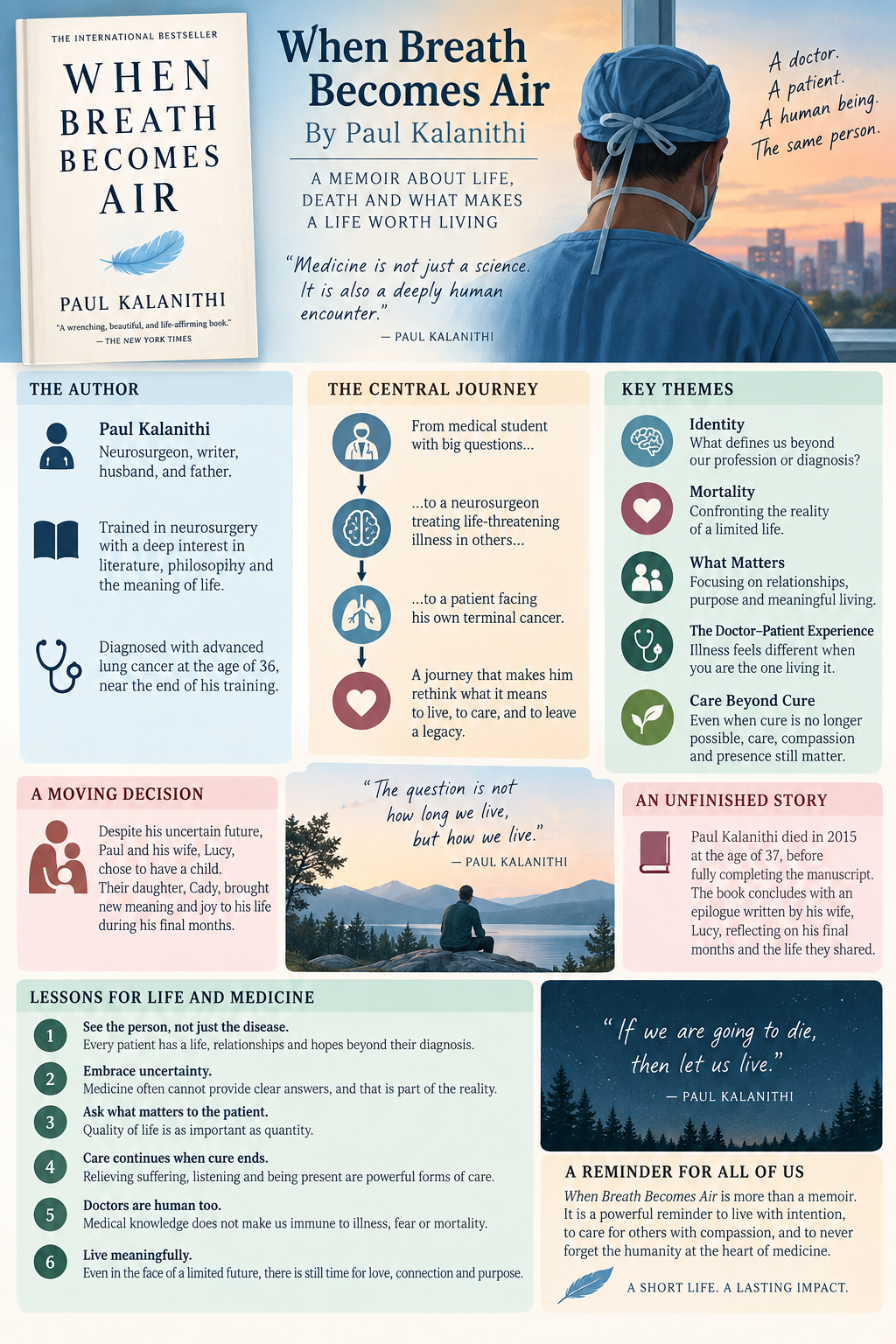
WHEN BREATH BECOMES AIR
By Paul Kalanithi
INTRODUCTION
When Breath Becomes Air is a deeply personal memoir by Paul Kalanithi, a neurosurgeon who spent years learning how to confront life-threatening illness in his patients—only to suddenly find himself on the other side of the doctor–patient relationship.
Near the completion of his neurosurgical training, Kalanithi was diagnosed with advanced lung cancer.
The physician became the patient.
The man who had spent years looking at scans, discussing prognoses and making difficult clinical decisions now had to confront the most difficult question of his own life:
What makes life worth living when you know that life may soon end?
---
FROM LITERATURE TO MEDICINE
Before becoming a doctor, Kalanithi was fascinated by literature, philosophy and the question of what gives human life meaning.
He eventually turned toward medicine because he believed that medicine occupied a unique place where:
• Biology meets humanity
• Science meets suffering
• Life meets death
• Knowledge meets uncertainty
Neurosurgery attracted him particularly because the brain is intimately connected with personality, identity, consciousness and everything that makes us human.
For him, neurosurgery was therefore not simply about operating on the brain.
It was about intervening in a person's identity, future and life story.
---
LIFE AS A NEUROSURGEON
Kalanithi describes the demanding world of neurosurgical residency.
Long hours.
Sleepless nights.
Emergency operations.
Critically ill patients.
Families waiting outside operating rooms.
Decisions where a few millimetres could determine whether someone would walk, speak or live independently again.
Gradually, he understood that being a good doctor required more than technical excellence.
A surgeon might successfully remove a tumour, but the patient could still lose the ability to communicate.
A procedure might prolong life, but the resulting life might not be one the patient would have wanted.
This leads to one of the central ideas of the book:
Medicine cannot simply ask, "Can we keep this person alive?"
It must also ask:
"What kind of life are we trying to preserve?"
---
WHEN THE DOCTOR BECOMES THE PATIENT
Kalanithi begins experiencing symptoms including persistent back pain and weight loss.
Eventually, investigations reveal metastatic lung cancer.
Suddenly, everything changes.
Yesterday he was interpreting scans.
Today, someone else is interpreting his.
Yesterday he was discussing prognosis.
Today, he wants to know his own.
Yesterday he was standing beside the hospital bed.
Today, he is lying in it.
The transition exposes something medical training can easily obscure:
A disease is experienced very differently by the person who has it than by the physician who treats it.
---
THE UNCERTAINTY OF PROGNOSIS
One of Kalanithi's struggles is understanding how much time he has left.
He wants numbers.
Months?
Years?
What should he plan?
Should he return to neurosurgery?
Should he abandon his career?
Should he travel?
Should he write?
Should he and his wife have a child?
But medicine cannot give him a precise answer.
His experience illustrates an important clinical truth:
Prognosis is often a probability, not a timetable.
Patients frequently ask:
"Doctor, how long do I have?"
Sometimes medicine simply does not know.
The physician's responsibility is therefore not merely to provide statistics but to help the patient live meaningfully within uncertainty.
---
RETURNING TO THE OPERATING ROOM
Despite cancer and treatment, Kalanithi attempts to return to neurosurgery.
This is important.
He does not want cancer to immediately redefine his entire identity.
He remains:
• A husband
• A doctor
• A surgeon
• A writer
• A son
• A friend
• A person with unfinished dreams
Illness changes his life, but he refuses to allow the diagnosis to become the only description of who he is.
---
THE DECISION TO HAVE A CHILD
One of the most moving parts of the memoir concerns Kalanithi and his wife, Lucy, deciding whether to have a child.
They know his future is uncertain.
Having a child could bring tremendous joy—but also the possibility that the child would grow up without a father.
They ultimately choose life despite uncertainty.
Their daughter, Cady, is born.
Fatherhood gives Kalanithi another dimension of meaning during the final stage of his life.
---
WHEN CURE IS NO LONGER THE ONLY GOAL
As his disease progresses, Kalanithi gradually moves from physician to patient, from treatment decisions to questions of mortality.
Medicine can sometimes cure disease.
Sometimes it can prolong survival.
Sometimes it can relieve suffering.
And sometimes its most important role is simply to accompany a human being through the final chapter of life.
This is one of the book's most powerful lessons for healthcare professionals:
Caring does not end when curing becomes impossible.
---
THE PERSON BEHIND THE PATIENT
Hospital medicine naturally reduces people into clinical summaries:
"Metastatic carcinoma."
"Bed 12."
"Post-operative case."
"Poor prognosis."
But every patient lying in a hospital bed has a world outside that bed.
Someone may be a parent.
Someone may have unfinished work.
Someone may be waiting to see a daughter married.
Someone may simply want enough strength to return home.
The book reminds clinicians that understanding those priorities is part of good medicine.
---
DEATH AND MEANING
Kalanithi does not present death simply as a medical failure.
Death is ultimately part of human existence.
The deeper question is what we do with the uncertain amount of time available to us.
His illness forces him to reconsider achievement, ambition, family, medicine and identity.
The question gradually changes from:
"How long will I live?"
to:
"How should I live the time that remains?"
---
THE UNFINISHED BOOK
Paul Kalanithi continued writing while his illness progressed.
He died in 2015 at the age of 37, before fully completing the manuscript.
The memoir concludes with an epilogue written by his wife, Lucy Kalanithi, describing his final illness, death and the life they shared.
This makes the book itself part of its message.
It is unfinished because life itself sometimes ends before our plans do.
---
LESSONS FOR MEDICAL STUDENTS & DOCTORS
1. THE PATIENT IS MORE THAN THE DIAGNOSIS
Never allow the disease to completely replace the person in front of you.
2. PROGNOSIS REQUIRES HUMILITY
Statistics describe populations.
They cannot perfectly predict an individual's future.
3. ASK WHAT MATTERS TO THE PATIENT
Before recommending aggressive treatment, understand what the patient considers an acceptable quality of life.
4. TECHNICAL SUCCESS IS NOT ALWAYS HUMAN SUCCESS
An operation may be technically successful while leaving the patient with an outcome they would never have chosen.
5. COMMUNICATION IS PART OF TREATMENT
How we explain illness, uncertainty and prognosis can profoundly influence how patients experience disease.
6. CARE CONTINUES WHEN CURE ENDS
When disease-modifying treatment is no longer possible, symptom relief, dignity, communication and presence become even more important.
7. DOCTORS ARE MORTAL TOO
Medical knowledge does not exempt physicians from illness, fear, uncertainty or death.
---
KEY LEARNING POINTS
• Medicine is both a science and a human relationship.
• A patient's values should influence major treatment decisions.
• Prognosis should be communicated with honesty and humility.
• Quality of life may sometimes matter more than simply extending life.
• Serious illness can alter identity, priorities and one's understanding of time.
• The inability to cure does not mean the inability to care.
• Every diagnosis belongs to a person with relationships, hopes, fears and unfinished stories.
---
TAKE-HOME MESSAGE
When Breath Becomes Air is not simply a memoir about a doctor dying from cancer.
It is a reflection on what happens when the person who has spent years fighting death finally has to face his own mortality.
Paul Kalanithi's journey reminds us that the purpose of medicine is not merely to extend biological life.
It is also to understand what makes that life meaningful to the person living it.
For a doctor, perhaps the greatest lesson is this:
Do not treat only the disease in front of you.
Understand the life that surrounds it.